
Best Peptide Companies in Canada (2026): What to Look For
How to Find the Best Peptide Company in Canada
The Canadian peptide market has grown significantly over the past two years. With that growth has come an influx of vendors — some legitimate, some questionable, and some outright fraudulent. For researchers who need reliable, high-purity compounds, knowing how to evaluate suppliers is essential.
This guide covers the criteria that actually matter when choosing a peptide vendor in Canada, common red flags to watch for, and what separates a research-grade supplier from a low-quality reseller.
The 8 Criteria That Matter Most
1. Third-Party COA Transparency
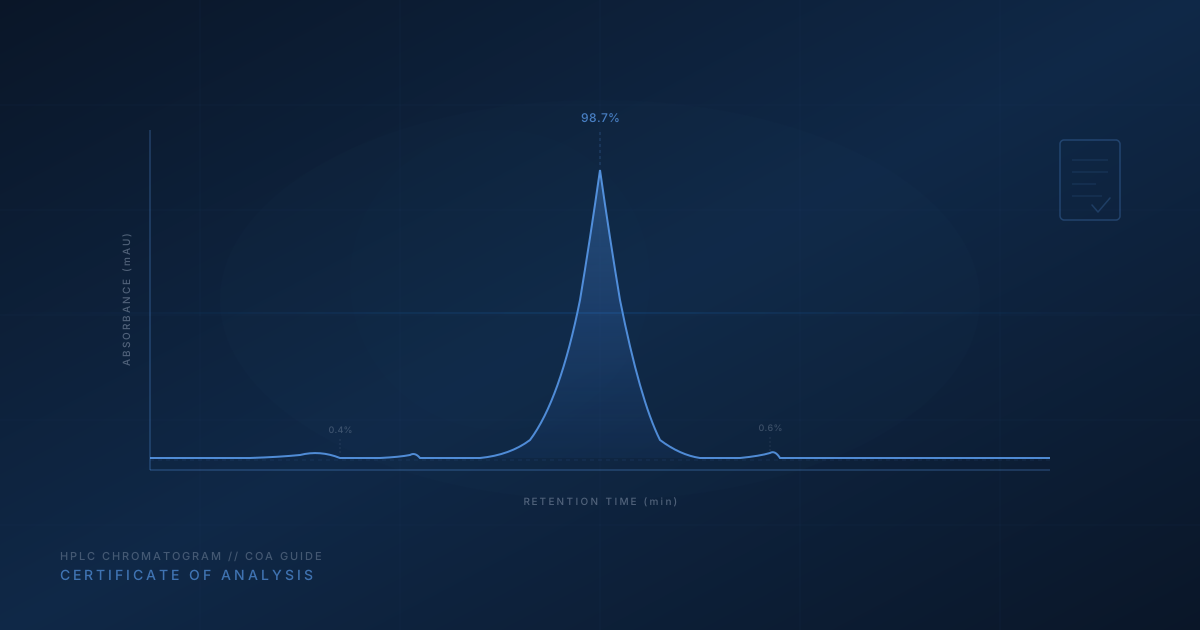
This is the single most important differentiator between peptide vendors. A Certificate of Analysis (COA) documents the purity, identity, and quality of each batch of peptide produced.
What to look for:
- Batch-specific COAs — each product listing should have a COA tied to the specific lot/batch you are purchasing, not a generic document
- Third-party testing — COAs from an independent laboratory carry more weight than in-house testing, which can be biased or fabricated
- HPLC purity results — the gold standard for peptide purity measurement
- Mass Spectrometry (MS) confirmation — verifies the molecular identity matches the claimed compound
- Accessible without asking — the best vendors publish COAs directly on product pages, not behind support tickets or email requests
Red flag: A vendor who says "COA available upon request" but does not publish them publicly may be using outdated, generic, or fabricated documentation.
2. Purity Standards (98%+ Minimum)
Research-grade peptides should consistently test at 98% purity or higher via HPLC analysis. This is the standard expected by research institutions and peer-reviewed journals.
Peptides below this threshold may contain:
- Truncated sequences (incomplete synthesis)
- Deletion peptides (missing amino acids)
- Oxidation products
- Residual solvents or TFA (trifluoroacetic acid) salts
These impurities can introduce confounding variables into experimental results, making reproducibility difficult or impossible.
Red flag: Vendors who claim "high purity" or "pharmaceutical grade" without publishing specific HPLC percentages are making unsubstantiated claims.
3. Domestic Canadian Shipping
For Canadian researchers, domestic shipping is a major advantage:
- No customs delays — international shipments can be held at the border for days or weeks
- No seizure risk — packages crossing international borders may be inspected and confiscated
- Faster delivery — 2-5 business days via Canada Post versus 2-4 weeks from international suppliers
- Tracking included — most Canadian vendors provide Canada Post tracking on every shipment
- No currency conversion — pricing in Canadian dollars with no hidden exchange rate fees
Red flag: A vendor claiming to be "Canadian" but shipping from a US or overseas warehouse is not a true domestic supplier.
4. Product Range and Catalog Depth
A well-established vendor typically carries a catalog of 15-40+ compounds spanning common research categories:
- Recovery/tissue research: BPC-157, TB-500
- Growth hormone research: CJC-1295, Ipamorelin, GHRP-6, GHRP-2
- Metabolic research: Semaglutide, AOD-9604, GH Fragment 176-191
- Skin/dermatological research: GHK-Cu, Melanotan II
- Immune research: Thymosin Alpha-1, LL-37
- Longevity research: Epithalon, MOTS-c, SS-31
- Neuropeptide research: Selank, Semax, KPV
A vendor with only 3-5 products is not necessarily a red flag (new vendors start small), but the depth of their catalog indicates how established their supply chain and quality testing infrastructure is.
5. Website Quality and Professionalism
The quality of a vendor's website reflects their overall operational standards. Look for:
- Detailed product pages with descriptions, molecular data, and storage instructions
- Published COAs on each product page
- Clear pricing in CAD
- Professional design that is not a generic template
- Contact information (email, phone, or form)
- Canadian business address
- Legal pages (privacy policy, terms and conditions, refund policy)
- "For research purposes only" disclaimers
Red flag: A website that looks hastily assembled, has broken links, stock photos, or no business contact information should be treated with caution.
6. Community Reputation
The peptide research community is active on Reddit (r/Peptides, r/PeptideSource), specialized forums, and review platforms like Trustpilot. Before purchasing from any vendor:
- Search the vendor name on Reddit and look for unprompted user reviews
- Check Trustpilot or Google Reviews for patterns (consistent positive feedback versus suspicious-looking 5-star reviews)
- Look for long-term community presence — vendors who have been discussed positively for months or years are more trustworthy than new, unreviewed operations
Red flag: A vendor with zero community discussion or only very recent, suspiciously positive reviews may be astroturfing or too new to have established a track record.
7. Payment Options
Canadian peptide vendors most commonly accept:
- Interac e-Transfer — the standard Canadian payment method, low fees, fast processing
- Cryptocurrency — Bitcoin, Ethereum — popular in this market for privacy
- Credit/debit cards — some vendors offer this, though payment processors sometimes restrict research chemical merchants
Interac e-Transfer is the most common and expected payment method from a Canadian vendor. It is fast, widely available, and avoids international processing fees.
8. Customer Support and Communication
A reliable vendor responds to inquiries within 24 hours, provides order tracking proactively, and communicates clearly about shipping timelines and product availability. Test their support before making a large order — send a question and see how quickly and thoroughly they respond.
Red flag: Vendors who are unreachable after taking payment, take days to respond, or provide vague answers to specific questions about testing methodology.
Common Red Flags to Watch For
| Red Flag | Why It Matters | |----------|---------------| | No COAs published | Cannot verify what you are actually receiving | | Prices far below market | Suspiciously cheap peptides often indicate low purity or counterfeit product | | No business address or contact info | No accountability if something goes wrong | | Health claims in product descriptions | Violates Canadian regulations — indicates a vendor willing to cut corners on compliance | | Only accepts cryptocurrency | May indicate a vendor trying to avoid traceability | | Generic or templated website | Often indicates a dropshipper or reseller, not a direct supplier | | Vague or missing refund policy | No recourse if product is damaged or incorrect | | COAs with no lab name or date | Likely fabricated or not batch-specific |
Price Benchmarks (CAD, 2026)
Knowing the typical price range helps identify vendors whose pricing is suspiciously low (quality concern) or unreasonably high (markup concern):
| Peptide | 5mg Vial Range | Notes | |---------|----------------|-------| | BPC-157 | $45 – $75 | Most popular; widely available | | TB-500 | $55 – $90 | Often paired with BPC-157 | | Ipamorelin | $35 – $60 | Common GH secretagogue | | CJC-1295 | $40 – $70 | Frequently bundled with Ipamorelin | | GHK-Cu | $35 – $55 | Popular for dermatological research | | Semaglutide | $85 – $140 | High demand drives premium pricing | | Epithalon | $40 – $65 | Longevity research compound | | Thymosin Alpha-1 | $50 – $80 | Immune research peptide |
Prices significantly below these ranges should prompt additional scrutiny of the vendor's quality documentation.
The Bottom Line
The best peptide company in Canada is one that prioritizes transparency over marketing. Look for published batch-specific COAs, 98%+ HPLC-verified purity, domestic Canadian shipping, a professional website with real contact information, and a track record in the research community.
The peptide market rewards diligence. Taking 15 minutes to verify a vendor's quality documentation and community reputation can save you weeks of compromised research results from substandard compounds.
All products sold by PinPoint Peptides are strictly for laboratory and research purposes only. Not for human consumption.
Related Resources
Written by
PinPoint Research Team
Research editors — PinPoint Peptides, Canada
The PinPoint Research Team is a collective of Canadian contributors focused on translating peer-reviewed peptide science into clear, accurate reference material for the research community. Every article is written with direct reference to primary literature, cross-checked against batch Certificates of Analysis, and reviewed for compliance with Canadian regulatory standards before publication.