Ipamorelin: The First Selective Growth Hormone Secretagogue
Mar 30, 2026·4 min read
Background
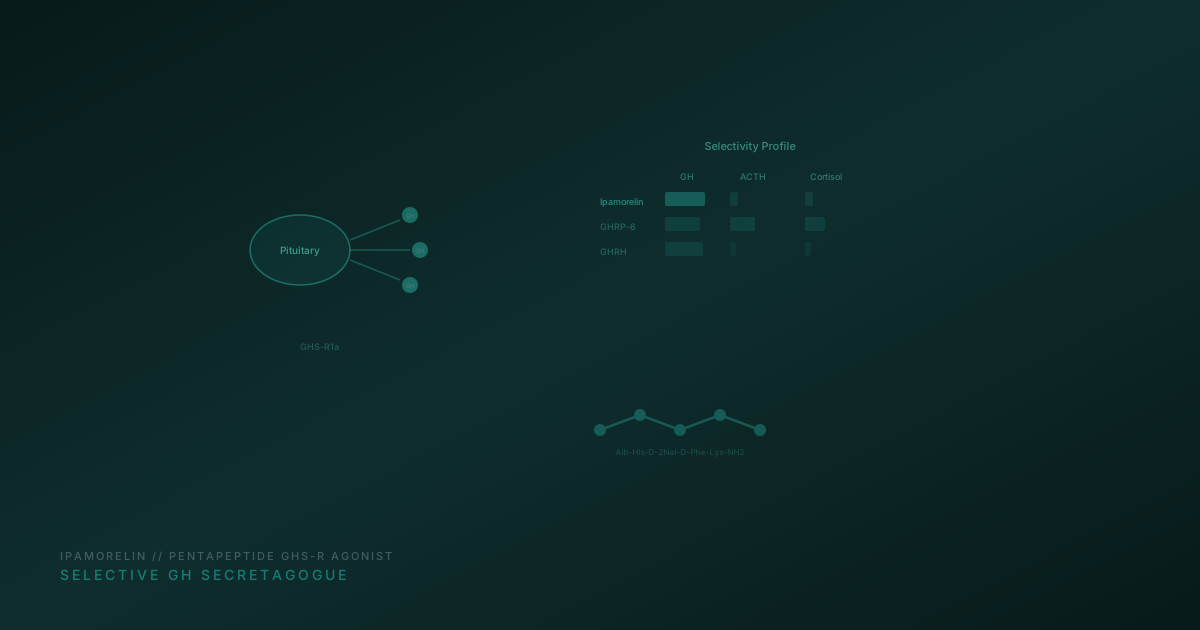
Ipamorelin is a synthetic pentapeptide (Aib-His-D-2-Nal-D-Phe-Lys-NH2) developed at Novo Nordisk A/S in Denmark as a growth hormone secretagogue (GHS). The compound binds to the growth hormone secretagogue receptor (GHS-R1a), the same receptor later identified as the ghrelin receptor. Ipamorelin was characterized as the first GHS-R agonist with a selectivity profile for growth hormone (GH) release comparable to that of native growth hormone-releasing hormone (GHRH).
The development of ipamorelin arose from systematic structure-activity relationship studies of growth hormone-releasing peptides (GHRPs), a class of synthetic peptides that stimulate GH secretion through a mechanism distinct from GHRH. Earlier GHRPs such as GHRP-6 and GHRP-2, while effective at stimulating GH release, also stimulated the release of adrenocorticotropic hormone (ACTH) and cortisol, limiting their research utility as selective GH secretagogues.
Selectivity Studies
The foundational publication on ipamorelin's selectivity was by Raun et al. (1998) in the European Journal of Endocrinology. This study demonstrated that ipamorelin displayed high GH releasing potency and efficacy both in vitro (using cultured rat pituitary cells) and in vivo (using swine and rat models). The study's central finding was that ipamorelin did not release ACTH or cortisol at levels significantly different from those observed following GHRH stimulation, even at doses more than 200-fold higher than the ED50 for GH release.
This selectivity profile was established through dose-response experiments measuring plasma levels of GH, ACTH, cortisol, prolactin, and luteinizing hormone simultaneously. The researchers demonstrated that while GHRP-6 produced dose-dependent increases in both GH and ACTH/cortisol, ipamorelin stimulated GH release without a proportional effect on the hypothalamic-pituitary-adrenal (HPA) axis.
Bone Mineral Content Studies
Andersen et al. (2001), publishing in Bone, examined the effects of ipamorelin on bone mineral content in adult female rats. The GH secretagogues ipamorelin and GHRP-6 were administered to adult ovariectomized rats for 12 weeks. The study reported that both compounds increased total body bone mineral content as measured by dual-energy X-ray absorptiometry (DXA), with ipamorelin producing measurable increases in bone formation markers.
Hansen et al. (2001), publishing in the European Journal of Endocrinology, extended these skeletal findings by examining ipamorelin's effects in a glucocorticoid-treated rat model. The study demonstrated that ipamorelin counteracted glucocorticoid-induced decreases in periosteal bone formation rate, as measured by fluorochrome labeling and histomorphometry. Maximum tetanic muscle tension was also increased in animals receiving combined glucocorticoid and ipamorelin treatment compared with glucocorticoid alone.
Growth Hormone Secretagogue Receptor
The mechanism of action of ipamorelin involves binding to GHS-R1a, a seven-transmembrane G protein-coupled receptor that signals through the Gq/11 pathway, increasing intracellular calcium and stimulating GH release from pituitary somatotrophs. Ishida et al. (2020), publishing in JCSM Rapid Communications, reviewed the history and mechanism of action of GHS-R agonists including ipamorelin, placing the compound within the broader context of ghrelin receptor pharmacology.
The review noted that GHS-R1a was identified as the endogenous receptor for ghrelin in 1999, one year after ipamorelin's characterization, retrospectively classifying ipamorelin as a ghrelin receptor agonist.
Laboratory Handling Notes
Ipamorelin is supplied as a lyophilized powder and should be stored at -20°C prior to reconstitution. The peptide should be reconstituted in sterile bacteriostatic water. Due to its pentapeptide structure, ipamorelin has a relatively short plasma half-life, which should be considered when designing experimental protocols.
All findings discussed in this article are derived from peer-reviewed investigations. This compound is intended for research applications only.
References
- Raun, K., et al. "Ipamorelin, the first selective growth hormone secretagogue." European Journal of Endocrinology 139.5 (1998): 552-561.
- Andersen, N.B., et al. "The GH secretagogues ipamorelin and GH-releasing peptide-6 increase bone mineral content in adult female rats." Journal of Endocrinology 165.3 (2000): 569-577.
- Hansen, B.S., et al. "The growth hormone secretagogue ipamorelin counteracts glucocorticoid-induced decrease in bone formation of adult rats." Growth Hormone & IGF Research 11.5 (2001): 266-272.
- Ishida, J., et al. "Growth hormone secretagogues: history, mechanism of action, and clinical development." JCSM Rapid Communications 3.1 (2020): 25-37.