Selank: Anxiolytic Neuropeptide Research
Apr 3, 2026·4 min read
Background
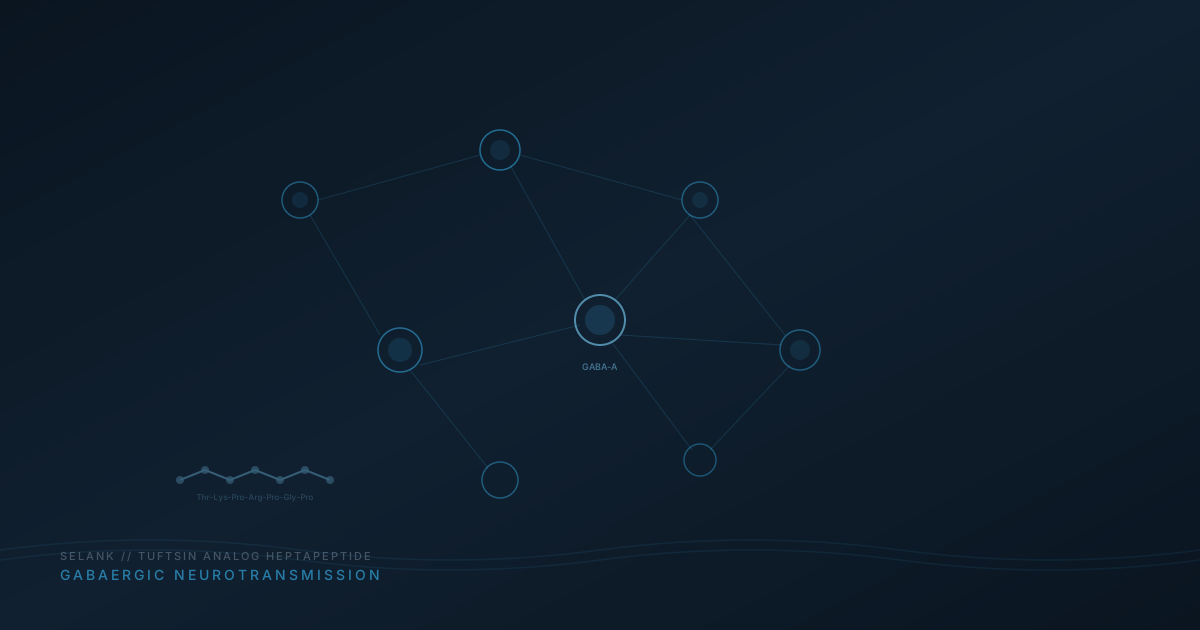
Selank (Thr-Lys-Pro-Arg-Pro-Gly-Pro) is a synthetic heptapeptide developed at the Institute of Molecular Genetics of the Russian Academy of Sciences. The compound is a structural analog of tuftsin (Thr-Lys-Pro-Arg), a naturally occurring tetrapeptide derived from the Fc region of immunoglobulin G heavy chain. Selank was created by extending the C-terminus of tuftsin with the tripeptide Pro-Gly-Pro, a modification designed to improve metabolic stability while retaining biological activity.
The compound has been the subject of published preclinical and clinical research, with studies appearing in peer-reviewed journals including Bulletin of Experimental Biology and Medicine, Zhurnal Vysshei Nervnoi Deyatelnosti (Journal of Higher Nervous Activity), and international journals indexed in PubMed.
GABAergic Neurotransmission Studies
A significant body of research has examined Selank's interactions with the GABAergic system. Kasian et al. (2017), publishing in Frontiers in Pharmacology, investigated the expression of genes involved in GABAergic neurotransmission in IMR-32 neuroblastoma cells following Selank treatment. The study reported that Selank influenced the expression of genes encoding GABA-A receptor subunits, GAD (glutamic acid decarboxylase) enzymes, and GABA transporters.
The researchers performed quantitative RT-PCR analysis and reported statistically significant changes in the expression of multiple GABAergic system genes, including upregulation of genes encoding specific GABA-A receptor subunits. These observations were obtained using standardized cell culture and molecular biology methodologies.
Additional research by Zozulya et al. (2001), published in Bulletin of Experimental Biology and Medicine, demonstrated that Selank influenced the binding properties of GABA-A receptors in membrane preparations from rat brain tissue. The study used radioligand binding assays with [3H]-flunitrazepam and reported measurable changes in binding parameters following peptide treatment.
Clinical Anxiety Research
Zozulya et al. (2008), publishing in Zhurnal Nevrologii i Psikhiatrii imeni S.S. Korsakova (S.S. Korsakov Journal of Neurology and Psychiatry), reported results from a clinical study comparing Selank to the benzodiazepine anxiolytic medazepam in patients with generalized anxiety disorder and neurasthenia. The study reported that Selank demonstrated anxiolytic effects comparable to medazepam, and additionally exhibited psychostimulant and antiasthenic effects that were not observed with the benzodiazepine comparator.
The study noted that Selank did not produce the sedation, muscle relaxation, or cognitive impairment associated with benzodiazepine administration. These clinical observations were obtained under controlled study conditions, though it should be noted that the study was conducted at a single center.
BDNF and Neuroprotection Research
Kozlovskii and Bhatt (2019), publishing in Bulletin of Experimental Biology and Medicine, examined Selank's effects on brain-derived neurotrophic factor (BDNF) expression in the hippocampus and prefrontal cortex of rats. The study reported that Selank administration regulated BDNF content in these brain regions and provided protection against ethanol-induced memory impairment as measured by passive avoidance testing.
These findings are consistent with earlier preclinical research suggesting that the peptide influences neurotrophic factor expression in brain regions associated with learning and memory. The methodologies employed standard behavioral testing protocols and immunoassay-based protein quantification.
Laboratory Handling Notes
Selank is supplied as a lyophilized powder and should be stored at -20°C. The peptide is soluble in water and physiological saline. Due to its small molecular weight, Selank is typically administered intranasally in published research protocols. Researchers should verify purity via the Certificate of Analysis provided with each lot.
All findings discussed in this article are derived from peer-reviewed laboratory and clinical investigations. This compound is intended for research applications only.
References
- Kasian, A., et al. "GABA, Selank, and olanzapine affect the expression of genes involved in GABAergic neurotransmission in IMR-32 cells." Frontiers in Pharmacology 8 (2017): 89.
- Zozulya, A.A., et al. "Efficacy and possible mechanisms of action of a new peptide anxiolytic Selank in the therapy of generalized anxiety disorders and neurasthenia." Zhurnal Nevrologii i Psikhiatrii imeni S.S. Korsakova 108.4 (2008): 38-48.
- Kozlovskii, I.I., Danchev, N.D. "Selank, peptide analogue of tuftsin, protects against ethanol-induced memory impairment by regulating of BDNF content in the hippocampus and prefrontal cortex in rats." Bulletin of Experimental Biology and Medicine 167.5 (2019): 641-644.
- Semenova, T.P., et al. "Selank enhances the effect of diazepam in reducing anxiety in unpredictable chronic mild stress conditions in rats." Bulletin of Experimental Biology and Medicine 162.3 (2017): 365-367.